
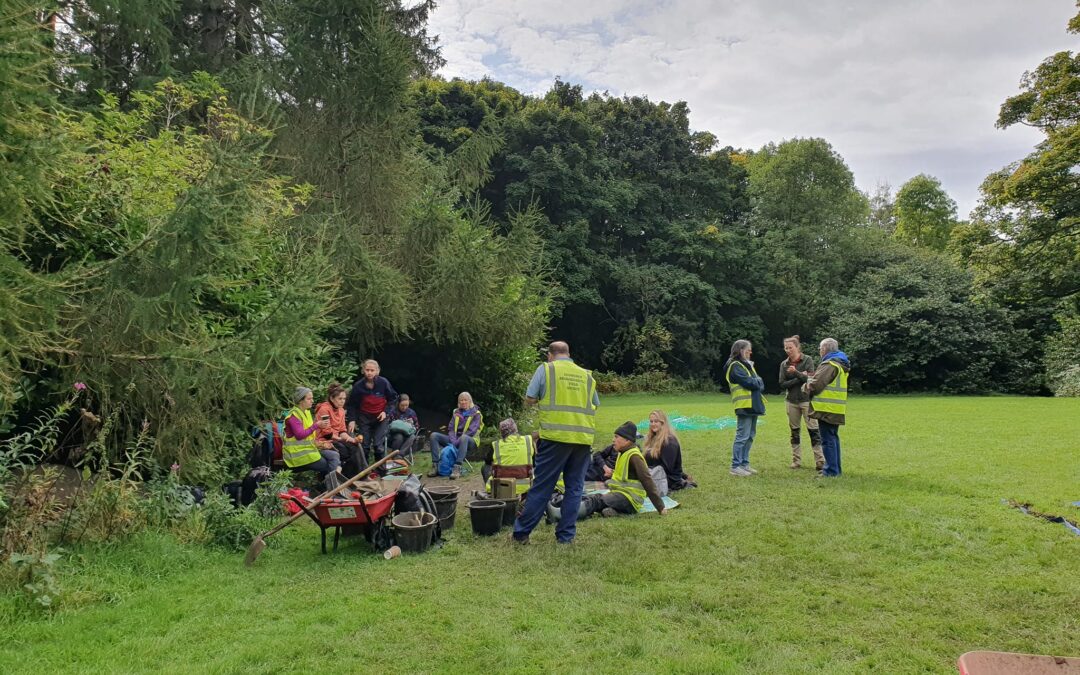
Since December 2023, we have completed clearing the ‘potting shed’ and small greenhouse on the outside of the south-east corner of the Walled Garden. Nothing new was discovered. 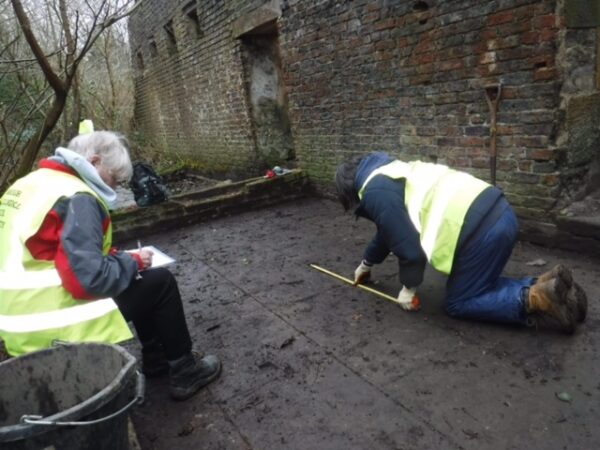
A few more areas of the glasshouse on the north wall were investigated and many of the ceramic tiles that created a border round the glasshouse were removed and given to the Friends of Cammo to be used to edge the beds at Cammo Lodge. In addition to many photographs, as much as possible of the excavation was drawn.
In October the City of Edinburgh Council (as landowners) organised the start of consolidation work, making old walls in the Walled Garden, stables and elsewhere, safe. This included rebuilding most of the south wall in the Walled Garden and removal of the ivy from the north wall. 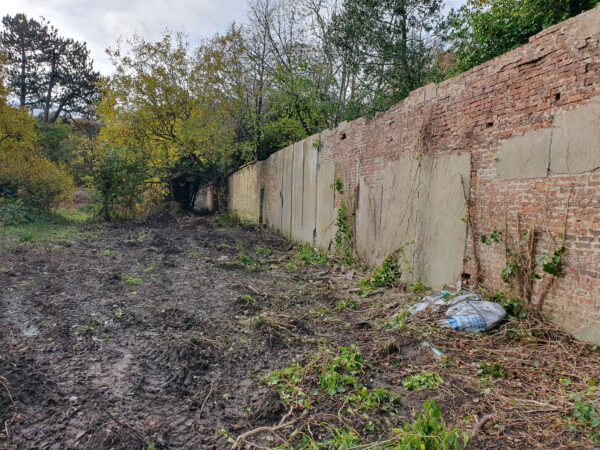 To do this, it was necessary to fill and level the whole of the glasshouse area.
The north wall after the removal of the ivy and the levelling of the ground, but before repair work was completed.
At the stables the shrubs and trees have been removed from the top of the building.
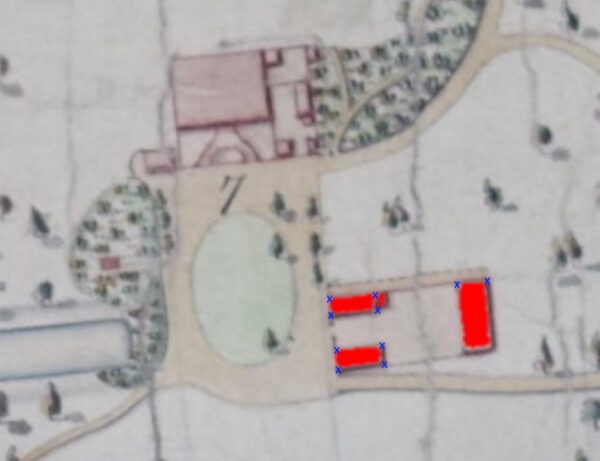 For the greater part of 2024, we have been investigating two buildings shown on the 1805 Cammo estate plan. We believe these were probably the 18th century stables, demolished on the completion of the new stable block in 1811. Using an overlay of modern maps on the old plans, points were identified as being the likely corners of these buildings.
The buildings highlighted in red are those we were hoping to find.
Three trenches were opened.
Trench 1 was dug in the open area to the SW of the house ruins. Because of the location, it had to be opened and back-filled every time – a laborious process, especially when it reached a depth of about 1.5 metres! “But that’s archaeology!” was the only comfort we could offer to the hard-working team involved. The section showed several distinct layers below the turf and topsoil, including a gravelly deposit we think was put down during the 1980s demolition of the house. Below this layer were traces of mortar but no large stones or signs of foundations. Small finds included shards of pottery, probably dating from the 18th and 19th centuries. 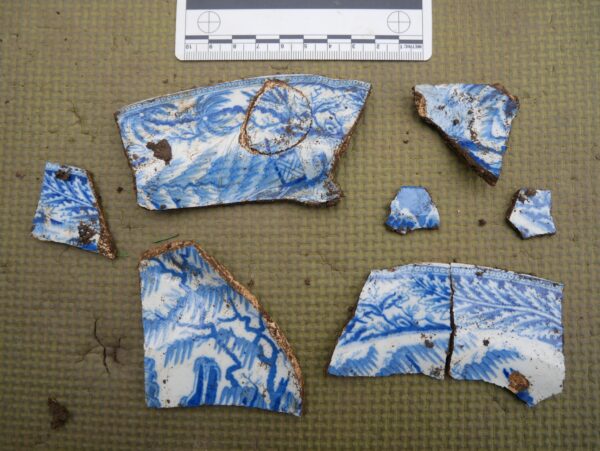
Trench 7 was disappointing and revealed nothing.
Trench 13/14 was initially only 1m2 but was extended through the summer and into autumn to become 3m x 2m . Context layers were very similar to those in Trench 1 . Below the gravel/gravelly soil layer there were quite significant traces, in parts up to 2cm thick, of mortar. These showed clearly in the section along the NE and SE sides of the trench, but there were no stones that could be considered structural. There were occasional small pieces of terracotta tiles at about the same depth as the mortar.
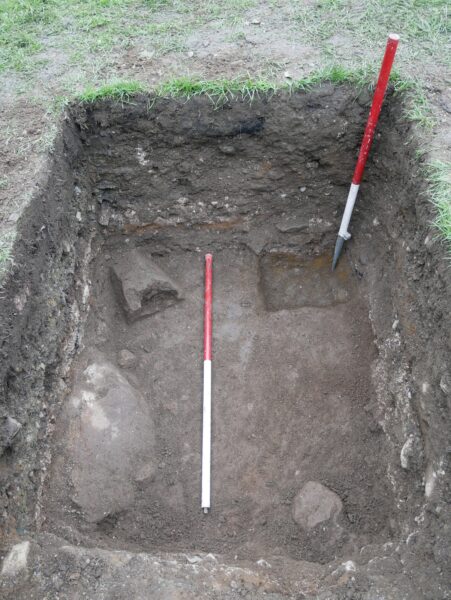
Trench 1 showing mortar in the section
Small finds included some pieces of more or less unidentifiable metal, a few shards of pottery and, most interestingly, a large dump of mostly thick, coloured glass in the SW corner of the trench. Helen Spencer, an expert in glassware, has provisionally confirmed that these were 18th century bottles. The trench was photographed and drawn, before being back-filled in November.
We were disappointed not to find more evidence of the buildings and nothing to confirm their original use. We believe that most probably the buildings were demolished sometime between 1805 and 1824, when they no longer show on the estate maps. The stone was removed and reused elsewhere. Any remaining mortar would then have been spread before the ground was grassed over.
The large boulders from the centre of the steading were removed during the consolidation work carried out by the Council. We were not given time to clear and record the whole area before it was levelled and compacted.
There are still features on the Cammo Estate that we would like to investigate. Next year we plan to look at the central area of the Walled Garden. The remains of the structure here is in the midst of a cluster of mature trees and covered with ivy, so clearing the undergrowth (in consulation with Friends of Cammo and the Council) will be a necessary first step. 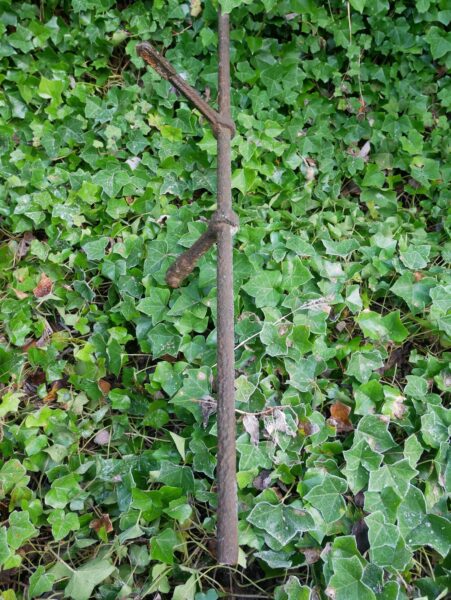 We would also like to carry out a geophysical survey of the strange rectangle marked on plans of the Walled Garden from 1805 onwards, perhaps leading to some excavation.
Found among the ivy in the centre of the Walled Garden, a metal rod believed to be part of the support for a glass roof or part of a mechanism to open windows in a greenhouse
We have acquired 2 display cabinets in the lodge where we are able to display some of our, providing interest for the local community.